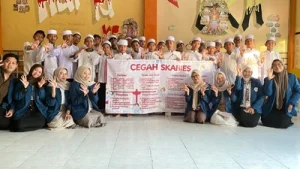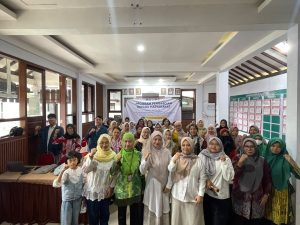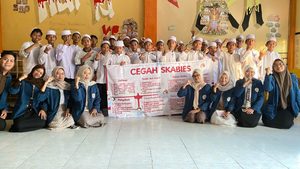


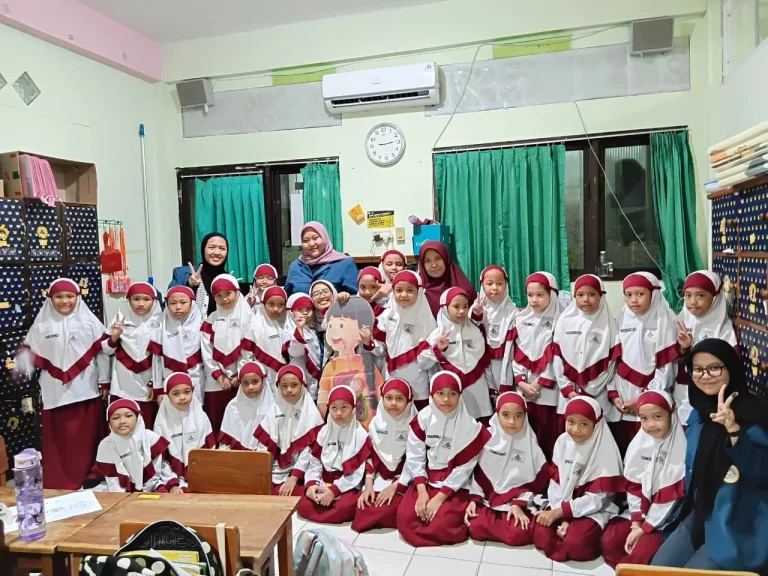
VOKASI NEWS – A team of nursing students from the Faculty of Vocational Studies, Universitas Airlangga, organized a community service project at SDIT Ghilmani Surabaya. The activity was held on Monday, April 6, 2026. Designed as an immersive and interactive crash course, this initiative centered on breaking down the complexities of human anatomy into digestible concepts. The primary objective was to introduce elementary students to the human digestive system using basic English as the instructional medium.
This creative educational movement was initiated by Group 1 of the GR-4A class. The team consisted of Syahida Silvi Dwi Amalia, Dea Nur Adhiba, Ratu Umamah, and Haura Raghdah Zakiyyah.To maintain high academic standards and clinical accuracy, the entire program was conducted under the supervision of Dr. Hafna Ilmy Muhalla, S.Kep., Ns., M.Kep., Sp.Kep. M.B. The guidance provided ensured that all educational activities were delivered appropriately and accurately. Furthermore, this supervision helped maintain the quality and credibility of the educational content throughout the program.
The Strategic Importance of Anatomy and Language Literacy
Focusing on the digestive system through an English-language lens was a strategic choice. The approach was designed to maximize the cognitive development and memory retention of elementary school children. Beyond simply expanding their vocabulary with essential foreign language terms, learning about body anatomy lays down a vital cornerstone for foundational health literacy. Instilling this knowledge early empowers children to build an active awareness and take better ownership of their physical well-being. Furthermore, this understanding can encourage the development of healthy habits from an early age.
Moreover, this grassroots academic project aligns directly with the Sustainable Development Goals (SDGs) actively championed by Universitas Airlangga. By integrating healthcare education with language learning, the program supported the achievement of SDGs Goal 3 (Good Health and Well-Being) and Goal 4 (Quality Education). This approach promoted both health awareness and educational development among participants.
Moreover, this dual-focused approach equips the younger generation with critical life skills and acute health mindfulness. As a result, the participants gain valuable knowledge that can support their well-being and learning development in the future.
Following the Delicious Adventure of Mr. Meatball
Following The Delicious Adventure of Mr. Meatball, the lively educational session continued in the 2D classroom at SDIT Ghilmani Surabaya. The activity opened with an energetic ice-breaking session to create an open and stress-free learning environment. Once the young participants were fully engaged, the room transformed into a storytelling arena. Moreover, the core science material was brought to life through a captivating narrative detailing the biological adventure of an animated character named “Mr. Meatball” traveling through the human body.
This unique storytelling technique proved highly effective in helping the young audience visualize intricate internal processes. Through the perspective of Mr. Meatball, the children eagerly followed the digestive process. The journey began in the mouth, continued through the esophagus and stomach, and ended in the intestinal tract. This whimsical approach allowed the students to understand how a simple everyday meal is processed and transformed into vital energy for their bodies. Furthermore, the engaging storyline helped maintain the children’s attention throughout the learning session. As a result, they were able to grasp the basic concepts of the digestive system more effectively.
Interactive Reinforcement via Custom Educational Boards
Immediately following the story, the students were challenged to test their memory and skills. The activity used custom-designed educational boards created by the student team. The main challenge featured the Organ Matching Game. In this activity, children eagerly stepped forward to place digestive organ cards in their correct positions on a colorful educational board. This hands-on activity bridged the gap between the narrative and anatomical reality.
In addition to organ mapping, the educational boards served as an interactive platform for the Healthy vs. Unhealthy Food Game. Students actively classified various food illustrations on the boards to understand what choices keep the digestive system running smoothly. The post-activity evaluation yielded highly positive results. Moreover, most of the schoolchildren were able to identify the English names of digestive organs and make informed choices regarding nutritious food options.
[BACA JUGA: Panduan Praktis Menyimpan Sediaan Obat Cair Secara Aman di Lingkungan Rumah]
Penulis: Ratu Umamah
Editor: Vioretha (Tim Vokasi Branding)