

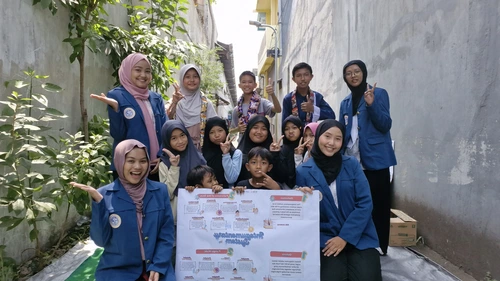
VOKASI NEWS – Learning becomes more meaningful when children are actively involved in the process. This idea inspired Group 5 of the Diploma III Nursing Program, Faculty of Vocational Studies, Universitas Airlangga, to organize a community health education activity on Saturday, April 11, 2026, at Jl. Kedinding Lor, Tanah Kali Kedinding, Surabaya.
The program involved ten children aged 9–14 years. It introduced the integumentary system through bilingual learning, interactive games, and creative educational media. The activity aimed not only to increase children’s understanding of skin health but also to build their confidence in using simple English vocabulary in everyday situations.
Understanding the Integumentary System through Engaging Activities
The integumentary system is the body’s first protective barrier, consisting of the skin, hair, nails, and glands. These components work together to protect the body from infection, regulate body temperature, and maintain overall health. Despite its important role, many children are still unfamiliar with proper skin care and healthy hygiene practices.
At the same time, English is becoming an increasingly essential skill for accessing information, education, and global communication. Combining health education with basic English learning offered an opportunity to introduce two valuable competencies in one engaging activity.
To create an enjoyable learning experience, the facilitators used a bilingual wall magazine entitled My Skin, My Amazing Protector! featuring colorful illustrations and simple explanations in both Indonesian and English. The session began with the “Guess Me” game to identify participants’ initial knowledge about skin anatomy and English vocabulary.
Interactive Learning Methods and Participant Engagement
Educational material was then delivered interactively, covering the structure and functions of the skin, common skin disorders, healthy skin care habits, and the importance of personal hygiene. Participants also practiced the six-step handwashing technique before completing the “Match Me” game, where they matched English terms, pictures, and skin functions as a fun post-learning evaluation.
The interactive approach created an enthusiastic learning atmosphere throughout the program. Children actively participated in discussions, answered questions confidently, and enjoyed every educational game. The post-activity evaluation showed that participants demonstrated a better understanding of the integumentary system. They also recognized more English vocabulary related to skin health and became more aware of the importance of maintaining healthy daily habits.
Although several participants were initially hesitant to pronounce English words such as skin, clean, healthy, and soap, their confidence gradually improved as the activities progressed. This experience demonstrated that English can be introduced naturally through meaningful health education rather than conventional classroom instruction.
Strengthening Health Literacy through Bilingual Education
This educational activity highlights the value of integrating health promotion with interactive bilingual learning. By combining games, visual media, practical demonstrations, and simple English communication, children were encouraged to learn in an enjoyable and supportive environment.
Beyond increasing knowledge about skin health, the program also helped foster curiosity, confidence, and active participation among participants. Similar educational initiatives have the potential to strengthen children’s health literacy while preparing them with basic English skills that will support their learning and everyday lives in the future.
[READ MORE: Kesesuaian APAR Meningkatkan Efektivitas Keselamatan di Industri Minyak dan Gas]
Writer: Nidya Athalia Nirmala, Zulfia Habidah, Dewi Humairo’, Asmawati Eka Kencananingsih
Supervisor: Dr. Hafna Ilmy Muhalla, S.Kep., Ns., M.Kep., Ns., Sp.Kep.M.B.
Editor: Vioretha (Tim Vokasi Branding)