


VOKASI NEWS – Have you ever thought that a routine injection could become a source of serious infection if performed incorrectly? Although injections are among the most common medical procedures used for medication administration, vaccination, hormone therapy, and chronic disease management, they must always be carried out using proper techniques. Unsafe injection practices can lead to pain, bleeding, tissue injury, local infections, abscesses, and even the transmission of bloodborne diseases such as hepatitis B, hepatitis C, and HIV. These risks highlight the importance of educating communities about safe injection practices, especially as more patients receive treatment at home. Therefore, safe injection infection’s practices are essential to ensure that injections are administered correctly, safely, and effectively.
In reality, injections are invasive medical procedures that require proper knowledge, technical skills, and strict infection prevention measures. A small mistake in injection procedures can lead to serious health problems. Examples include using non-sterile equipment, choosing the wrong injection site, or disposing of used needles improperly. These errors may result in local infections, tissue damage, and even the transmission of life-threatening diseases such as hepatitis B, hepatitis C, and HIV.
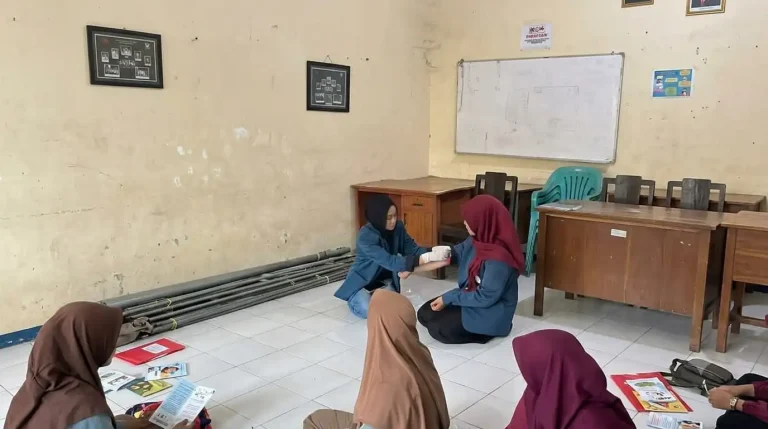
Recognizing these challenges, nursing students from the Diploma III Nursing Program, Faculty of Vocational Studies, Airlangga University, organized a health education activity. The program was held on Sunday, April 26, 2026, at Jl. Medokan Timur Gg. 4 No. 53, Surabaya. This activity involved 15 participants. It was designed to be interactive and engaging by combining presentations, demonstrations, educational videos, discussions, and hands-on learning experiences.
Understanding Safe Injection Practices
Safe injection begins with understanding that each injection route serves a different purpose and requires a specific technique. There are four main routes of injection administration. Intramuscular (IM) injections are commonly used for vaccines and antibiotics, while Subcutaneous (SC) injections are used for insulin and anticoagulants. Intravenous (IV) injections are administered for emergency medications and fluid therapy, whereas Intradermal (ID) injections are primarily used for diagnostic procedures such as allergy and tuberculosis skin tests. Selecting the correct injection site, needle angle, and depth ensures effective drug absorption while minimizing complications (WHO, 2021).
Equally important are the principles of aseptic and antiseptic techniques. Proper hand hygiene is an essential step in preventing infection during injection procedures. Skin disinfection should also be performed to reduce the risk of contamination at the injection site. In addition, sterile single-use syringes and needles must be used, and all used sharps should be immediately disposed of in puncture-resistant safety containers. Adhering to these standards not only protects patients but also safeguards healthcare workers and the surrounding community from accidental exposure to infectious agents (WHO, 2022).
Realife Demonstrations, Practical Learning, and Safe Disposal of Medical Waste
The atmosphere of the activity became more lively when the team began a practical session on safe injections using props. Through this simulation, participants were able to directly observe each crucial step in the injection procedure. They learned the importance of maintaining proper hand hygiene and ensuring that all equipment remained sterile before use. Participants also observed how to select the appropriate injection site and perform correct needle insertion and removal techniques. This hands-on presentation made previously complex information more understandable and helped participants visualize its application in everyday situations.
In addition to discussing proper injection techniques, this activity also placed special emphasis on the importance of household medical waste management. Participants learned that used syringes should not be disposed of with domestic waste, as they pose a danger to sanitation workers and the public, and increase the risk of environmental pollution. As a preventative measure, participants were introduced to the use of Safety Boxes, or puncture-resistant containers, as temporary storage for sharps waste before being handed over to healthcare facilities to ensure proper destruction.
Participant Engagement and Activity Evaluation
The participants’ enthusiasm was further evident during the interactive question-and-answer session. Various questions were raised about common home injection practices, such as how to safely administer insulin to people with diabetes, steps to prevent post-injection infections, and what to do if post-injection symptoms arise. This lively discussion demonstrated the public’s strong interest in obtaining practical, accurate, and applicable health information in their daily lives.
To conclude the series of activities, participants took a post-test to measure their understanding after receiving all the educational materials. The evaluation results showed a significant increase in knowledge compared to before the event. The event concluded with awards to the most active participants during the educational session as a token of appreciation for their participation. This was followed by a documentation session with all participants and the committee before the official end of the event.
Community Education for Safer Healthcare
To improve public awareness, this educational program was designed using an interactive learning approach. Participants received information on the basic concepts of injection, different injection techniques, infection prevention principles, common injection errors, and proper medical waste disposal. The materials were delivered through lectures, discussions, demonstrations, educational videos, simulations, and printed leaflets. This combination of learning methods was intended to help participants gain both theoretical knowledge and practical skills.
Through these activities, participants are expected to develop greater confidence in recognizing and applying safe injection techniques in daily life. Ultimately, strengthening community knowledge is essential for improving the safety of injection practices. Increased awareness can help reduce injection-related complications and prevent the transmission of infectious diseases. In the long term, these efforts can promote safer healthcare practices for individuals, families, and the wider community.
[READ MORE: Kobarkan Semangat Juang Muda, AIMMEX CUP 2026 Siap Dominasi Lapangan Futsal Surabaya]
Author: Afriza Lutfia Inayatullah
Supervisor: Dr. Hafna Ilmy Muhalla, S.Kep., Ns., M. Kep., Ns., Sp. Kep.MB
Editor: Aghnia Faiza (Tim Branding Vokasi)