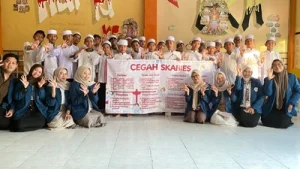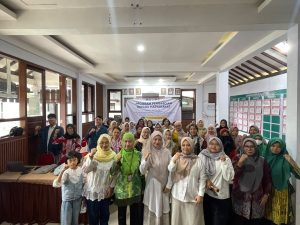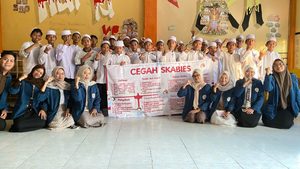


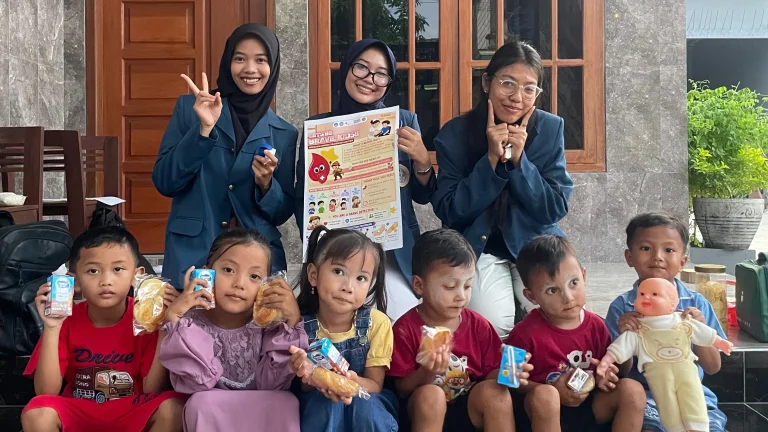
VOKASI NEWS – The health education activity took place on Saturday in Mlaten Hamlet, Bandungsari Village, Sukodadi District, Lamongan Regency. Direct interactions were conducted with children from Kindergarten A and Kindergarten B. The indoor activity proceeded without the presence of classroom teachers. This condition provided an opportunity for honest observation regarding the natural responses of early childhood.
Baseline Condition and Children’s Perception Toward Medical Procedures
When the Q&A session about syringes commenced, the majority of the children spontaneously expressed fear. Injection procedures and encounters with medical personnel were perceived as highly terrifying experiences.
Consequently, this high level of emotional distress served as a strong indicator of the deep-rooted negative stigma surrounding medical procedures among preschool children. Therefore, these findings underscore the importance of introducing child-friendly interventions to alleviate anxiety and promote positive perceptions of healthcare experiences from an early age.
Education on Calming Strategies Through Visual Poster Media
To overcome this anxiety, the children’s attention was diverted through the delivery of health education using an engaging visual poster. Through this colorful medium, explanations were provided regarding five simple steps to remain calm and brave during an injection. Specifically, these steps included taking a deep breath, looking away from the needle, and holding a toy or a friend’s hand.
Furthermore, the children were encouraged to think about their favorite stories and remain still like a strong detective. This explanation, driven by friendly character illustrations, proved effective in instilling basic coping strategies in early childhood.
Practical Intervention Through Role-Play Method
The education was extended to a more interactive practical intervention stage through the role-play method. The sequence of the blood sampling procedure was demonstrated in a realistic yet completely safe manner using medical simulation toys. Clinical steps were introduced progressively, starting from the application of a venous tourniquet to the skin disinfection technique using an alcohol swab. The simulated needle insertion to collect blood samples was also demonstrated sequentially. Opportunities for active participation were given to the children to come forward and act as little doctors or little nurses.
“The purpose of this role-play method is to alter children’s perception of syringes from something terrifying into a fun and educational game,” stated Febrianti, a representative of the student organizing team.
Attitude Transformation: From Fear to Enthusiasm
The transition from theoretical education to the hands-on role-play simulation brought an extraordinary psychological shift among the children. However, the tense atmosphere that initially filled the room immediately dissolved, as the clinical simulation proved to be completely non-threatening.
The fearful response observed at the beginning of the activity turned drastically into a burst of high enthusiasm. However, this reaction quickly transformed into high enthusiasm as the activity progressed. Consequently, the children became incredibly excited and cheerful, and they even competed with one another for the opportunity to practice each clinical step themselves. Introducing clinical procedures through experiential learning proved highly effective in instantly diminishing needle phobia in children.
[BACA JUGA: Strategi Hotel ABC Jaga Kepercayaan Vendor Lewat Pengendalian Hutang Usaha]
Contribution to SDGs Goal 4: Quality Education
Moreover, the success of this course project series contributes significantly to the fourth target of the Sustainable Development Goals (SDGs). Specifically, this game-based approach to health literacy demonstrates that quality education can be delivered in a flexible and engaging manner. Furthermore, the use of interactive posters and independent practice to convey complex clinical concepts serves as an inclusive and accessible learning model. Therefore, this initiative highlights the potential of innovative educational strategies to promote equitable learning opportunities for children.
This academic project by D-III Nursing students of Airlangga University successfully provides new knowledge outside the formal curriculum. Ultimately, the program contributed to building a foundation for developing brave, adaptive, and health-conscious character traits during the golden age of child development.
Writer: Karisma Febrianti, Nabillah Fasya Aulia, Alfi Mahdiyah Rahmawati
Mentor: Hafna Ilmy
Editor: Vioretha (Tim Vokasi Branding)