

VOKASI NEWS – Vision education was delivered by combining myth-and-fact games commonly found in the
community. People tend to rely on treatment based on surrounding experiences without further verifying the accuracy of the information. This condition underlies the implementation of an interactive vision education activity through myth-and-fact games. In addition to increasing knowledge about eye health, this activity also helps participants understand whether circulating issues belong to myths or facts.
Education Activity Profile
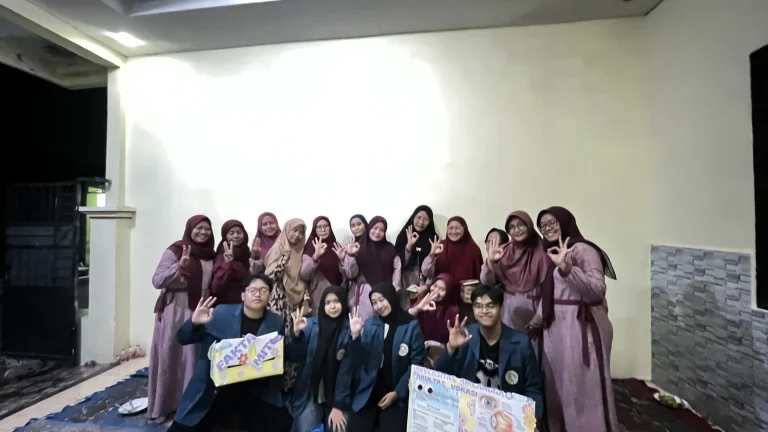
The activity was conducted on Friday, April 17, 2026, after a yasinan gathering at one of the group member’s houses at 7:00 PM. The location was Perumtas 3 Blok K.8/04, Kepuh Kemiri, Tulangan, Sidoarjo. The target participants were 16 women from the surrounding community. The activity aimed to improve knowledge of eye health and correct misconceptions related to myths and facts in the community.
Learning Method
The activity was carried out by Group 3 GR-4A, consisting of Ussy, Ulum, Nino, and Angga. The learning method was designed to be interactive using various educational media, including leaflets, a myth-and-fact spin wheel, wall magazines (mading), posters, and eye anatomy visuals. All materials were presented using a bilingual approach (English and Indonesian) to facilitate gradual understanding, especially in recognizing eye health terminology.
Myth and Fact Games
The activity began with participant registration conducted simultaneously with the opening session. Next, participants received education through leaflets and explanations using the wall magazine. The session continued with the myth-and-fact game as a reinforcement of the material.
In this game, participants were given paper to write their answers. The spin wheel was then used to display statements, and participants were asked to determine whether each statement was a myth or a fact. This method increased participant engagement and encouraged critical thinking toward information circulating in the community.
Learning Evaluation: Pre-Test and Post-Test
Evaluation was conducted using pre-tests and post-tests to measure participants’ understanding. The pre-test was given before the material delivery to assess initial knowledge regarding eye health and related myths and facts.
After completing all educational sessions and activities, participants were given a post-test to evaluate the improvement in their understanding. The results showed an increase in participants’ knowledge, particularly in distinguishing myths from facts related to eye health. This indicates that the educational method used was effective in improving community understanding.
As a form of appreciation, rewards were given to all participants, including those who actively participated during the activity. The session was then concluded with a documentation session as a memorable closing of this community service activity.
[READ MORE: Edukasi Penglihatan Berbasis Games: Membedah Mitos dan Fakta di Masyarakat]
Penulis: Ussy Rahmasari
Editor: Vioretha (Tim Vokasi Branding)